Everyone Is Optimising the Wrong Layer
Walk through the pitch of almost any AI-led sales tool released in the last two years and you'll hear a version of the same promise: better personalisation, faster drafting, smarter sequencing. The entire category has converged on one question — how do we help you write to more people, faster, in a way that sounds like you meant it?
That question was worth solving in 2022. It isn't anymore. Every credible language model can now produce a plausible, personalised outbound email in under ten seconds. Writing quality stopped being the bottleneck. Nobody's pipeline problem today is that the emails read badly.
The actual bottleneck moved one layer upstream, and almost nothing in the market followed it there: deciding whether a given company deserves outreach at all.
The Math Is Quietly Catastrophic
We ran outbound for enterprise clients across the GCC and India for over two decades before we built anything. We bought every tool on the market. We watched every one of them get better at sending and no better at deciding whether sending was the right call.
An SDR in India costs ₹60,000–80,000 per month. In the US, $5,000–8,000. They send forty to fifty emails a day, twenty LinkedIn touches, a handful of calls. Open rates on a good day: 30–40%. Reply rates: 2–5%. By month three, most are burned out. By month six, they're gone. You hire another one. Same output. Same churn. Same empty pipeline report.
The volume-led model doesn't fail occasionally. It fails structurally, every time — because the problem was never the send rate. It was that nothing in the pipeline was ever asked to decide whether sending was justified in the first place.
The Cost of Guessing Isn't the Email. It's Everything Before It.
Every outbound programme we've run has the same structural leak. Someone builds a target list. Every company on it looks, on paper, like a reasonable prospect. The SDR researches, drafts, sends. Most of it goes nowhere, because "looks like a reasonable prospect on paper" and "has a real, current reason to buy right now" are two entirely different claims, and almost nothing in the pipeline distinguishes between them before the send button gets pressed.
We used Apollo. We used Clay. We used ChatGPT and half a dozen AI writing tools that promised to fix outbound with smarter copy and better cadences. They all optimised the same thing: production. None of them fixed the fundamental problem — every one of them will write an email the moment you ask, regardless of whether there's any real reason to.
Five Stages, Two Gates
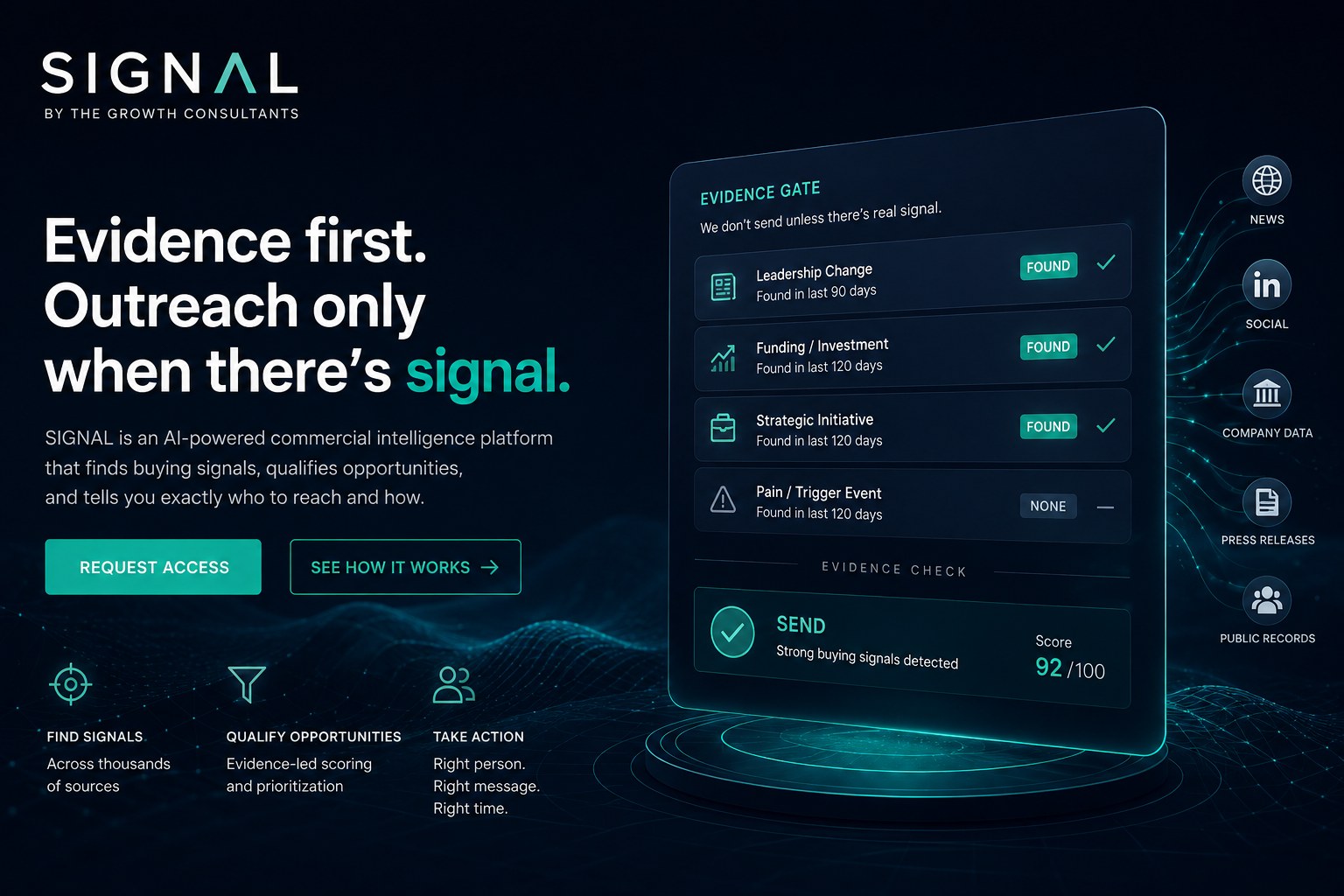
SIGNAL is built around a doctrine we've repeated internally long enough that it's stopped feeling like a slogan and started feeling like an operating principle: No Signal. No Send. It plays out as five stages, structured around two real gates — not one blended judgement call.
Stage 1 — Qualify (Gate One). Before a cent is spent on research, a free structured check sorts every company into Drop, Verify, or Pursue. Wrong industry, wrong size, no plausible need — dropped instantly, no research spend at all.
Stage 2 — Research. For every company that qualifies, SIGNAL researches across live-search-backed dimensions — public complaints and reviews, call-intent signals, KPI mapping by contact role, and transformation signals from job postings, press releases, and company news. Every finding is labelled by how sure it actually is: verified, inferred, or not found.
Stage 3 — Score. Four independent factors — Research strength, Persona fit, Timing, and Relevance — are scored separately, then combined into a single Commercial Opportunity Score. Independently scored, so a strong signal in one dimension can't quietly paper over a weak one in another.
Stage 4 — Decide (Gate Two). The Commercial Opportunity Score drives a Send, Role-Based, or No-Send decision — with the reasoning shown, not hidden inside a black box. If the evidence doesn't clear the bar, SIGNAL says so and stops.
Stage 5 — Engage. Only for companies that clear the gate: outreach grounded strictly in what was actually found. Every claim in the message traces back to a research finding or is explicitly marked as an inference.

SIGNAL — Evidence-Led Commercial Intelligence. Powered by The Growth Consultants.
The Refusal Is the Product
Here's the part that's easy to miss: the refusal isn't a safety feature bolted onto a generation tool. It's the actual intellectual property. Any competent model can write your next email. Deciding whether that email is worth writing — consistently, defensibly, at scale, without a human re-litigating every single call — is a genuinely hard problem, and it's the one almost nobody has actually built for.
That's also why "personalisation" as an industry buzzword has quietly become almost meaningless. Swapping in a company name and a plausible-sounding industry pain point isn't personalisation. It's mail-merge with better vocabulary. Real personalisation requires the system to have actually checked whether the thing it's about to say is true for this specific company, right now — and to say nothing if it isn't.
Generic AI personalises language. SIGNAL personalises judgement.
Not a Data Reseller. Not a Guessing Tool. Not a Mass Emailer.
Being clear about the edges matters as much as the promise. Any third-party data SIGNAL uses — contact data, search results — is one input among several. What a customer receives is SIGNAL's own analysis, never someone else's raw database repackaged. If research finds nothing, SIGNAL says so and shifts to a role-based approach rather than fabricating a reason to reach out.
What's Proven Today, and What's Roadmap
| Proven Today | What It Means in Practice |
|---|---|
| Company Qualification & Research | Drop / Verify / Pursue tiering, then live-search-backed research only on companies that qualify. |
| Commercial Opportunity Scoring | Four factors — Research, Persona, Timing, Relevance — combined into one score, reasoning shown. |
| Send / Role-Based / No-Send Decisions | The evidence gate. No verified signal means no fabricated one. |
| Evidence-Grounded Generation | Email and LinkedIn messages, generated only when the evidence supports it. |
| Roadmap — Same Doctrine | What It Means in Practice |
| Account Qualification & Deal Scoring | The same evidence layer applied further down the funnel. |
| Territory & White-Space Prioritisation | Where the evidence says opportunity actually concentrates. |
| Competitive Displacement Signals | Evidence of vulnerability, not assumption of it. |
| Partner Targeting & Board-Ready Reports | The same refusal discipline, applied to a different output. |
What This Actually Looks Like Day to Day
In practice, this doctrine changes what a "good pipeline day" looks like. It's not measured by how many messages went out. It's measured by how many companies got correctly told "not yet" before anyone's time was spent on them, and how few of the messages that did go out came back with a reply pointing out that the premise was wrong.
A person still reviews before anything reaches a company. SIGNAL's job isn't to send. It's to make sure nothing gets sent without a reason behind it.
Why This, Not Just a General AI Tool
Any large language model will write you a plausible outbound email the moment you ask. That was never the hard part. The hard part — the part no general-purpose AI tool is built to do — is deciding whether that email should be written at all.
ChatGPT answers the question you give it. SIGNAL decides whether the question should have been asked in the first place. That's a different job, and it's the one that actually moves conversion, because the real cost of outbound was never the writing. It was the volume of well-written messages sent to companies that were never going to buy.
SIGNAL is built for teams entering or expanding a market, in any industry — across the USA, Middle East, India, Australia, Europe and the UK. ABM teams targeting enterprise accounts. SDR teams burning out at low conversion. Agencies managing outbound across multiple clients. Fractional CGOs and CROs running outreach across portfolio companies.
SIGNAL Powers TGC's Expand Pillar
SIGNAL isn't a standalone tool bolted onto TGC's service line — it's the decision-intelligence engine inside the Expand pillar, one of TGC's three co-equal operating pillars alongside Land (market entry) and Grow (operational scaling, powered by the DOSA framework). Expand answers who deserves engagement. SIGNAL is how that answer gets decided with evidence instead of a guess.
Join the SIGNAL Waitlist
SIGNAL is being introduced to a small number of teams before wider access. Tell us about the market and companies you're evaluating.
Join the Waitlist →